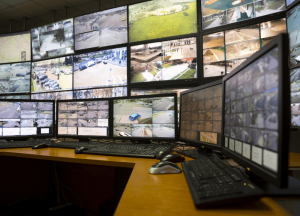
How airport control rooms keep operations running smoothly
Airport control rooms are staffed operations centers where teams monitor and coordinate baggage handling, security, facilities, passenger flow, and airside activity from a shared view. Air traffic control manages aircraft movement, but much of what decides whether a flight leaves on time happens on the ground and inside the terminal. Control rooms bring those systems together so operators can spot problems early and act on them fast. Large displays, video wall controllers, and remote access tools give each team the information it needs at the moment it needs it.
At a glance
- Airport control rooms coordinate five core areas: baggage handling, security, facilities, passenger flow, and operational coordination.
- An airport operations control center (AOCC) gives every team a shared operational picture instead of separate departmental views.
- Video wall controllers distribute camera feeds, system dashboards, and flight data across large display arrays.
- IP KVM (keyboard, video, and mouse over IP) lets operators reach critical systems from the control room or from a remote location.
- Centralized platforms such as Aetria manage layouts, source routing, and operator access in one place.
Want to see this in action?
Explore how video wall controllers handle dense, multi-source control room layouts.
What does an airport control room actually do?
An airport control room, often called an airport operations control center (AOCC), gives operators one view of everything that affects the passenger journey. Air traffic control focuses on aircraft movement, while the AOCC covers the ground and terminal side: gates, baggage, security, building systems, and queues. When one area slips, the effects reach the others within minutes, so a shared picture matters more than any single feed.
How do airport control rooms manage baggage systems?
Baggage handling systems run on conveyors, sorters, screening points, and loading stations spread across a large facility. Operators watch throughput, jams, and screening status on live dashboards and camera feeds. Early visibility lets teams reroute bags or send staff to a fault before a backlog reaches the aircraft.
How do control rooms support airport security?
Security operators monitor checkpoint queues, perimeter cameras, access control events, and alarms. These sources produce a constant stream of video and data, and the display layer decides how quickly an operator can spot what matters. Video wall controllers let teams pull any camera or alert onto a shared display the moment a situation develops.
Why do facilities teams need a place in the control room?
Power, HVAC, lighting, lifts, escalators, and fire systems all affect terminal operations. A failed escalator or an overheating zone creates passenger flow problems that security and customer service teams then have to manage. Placing building management dashboards beside operational feeds helps teams link cause and effect without calling across departments.
Free guide: key considerations for control room design
Learn how to plan displays, sources, and operator workflows for 24/7 environments.
How do airport control rooms track passenger flow?
Passenger flow monitoring tracks how people move through check in, security, immigration, retail areas, and gates. Operators combine camera views, queue time data, and flight schedules to see congestion forming. With that view, teams can open additional lanes, adjust staffing, or redirect passengers before delays spread.
How do teams coordinate across departments?
Coordination is where control rooms earn their value. Airport collaborative decision making (A-CDM) is a process that shares accurate, timely information between airports, airlines, ground handlers, and air traffic control. In the control room, that shared data appears on large displays that every operator reads at the same time, so decisions rest on the same facts.
What technology do airport control rooms rely on?
Airport control rooms display many source types at once, from IP camera streams and workstation outputs to dashboards and legacy video. Video wall controllers handle scaling, pixel mapping, and layout control across the display array. IP KVM extends operator access to remote systems, and centralized management software keeps layouts, source routing, and permissions consistent across shifts. Datapath builds these layers, including the VSN Series, Aligo, Arqa, and Aetria.
Frequently asked questions
What is an airport control room?
An airport control room is a staffed operations center that monitors and coordinates baggage, security, facilities, passenger flow, and ground operations. It is often called an airport operations control center (AOCC). Operators use large displays to see all of these areas in one place.
What is the difference between an airport control room and air traffic control?
Air traffic control directs aircraft in the air and on runways and taxiways. An airport control room manages the terminal and ground operations that support those flights, including baggage, security, building systems, and passenger flow. The two work together and share information, but they serve different functions.
What systems does an airport operations control center monitor?
Typical sources include baggage handling dashboards, security cameras, access control, building management systems, flight information, and queue time data. The exact mix depends on the airport. The goal is to bring these sources into one shared view.
How does a video wall help airport operations?
A video wall gives every operator in the room the same large, high-detail view of live sources. Teams can pin a critical camera or dashboard and share it instantly. This reduces the time spent switching between systems or relaying information by phone.
What is IP KVM and why do airport control rooms use it?
IP KVM (keyboard, video, and mouse over IP) lets an operator control a remote computer over the network as if sitting at it. Airport control rooms use it to reach servers and workstations located elsewhere in the facility. Datapath offers Aligo for 4K and Arqa for HD IP KVM.
What is EDID management and why does it matter in a control room?
How does Datapath support airport control rooms?
The VSN Series provides configurable video wall controllers, and Aetria provides centralized control room management and operation. Aligo and Arqa provide IP KVM access, and Image graphics cards support multi-display operator workstations. Together they cover display, access, and management needs.
Plan your airport control rooms with Datapath
Talk to our team about displays, sources, and operator workflows for your terminal operations.