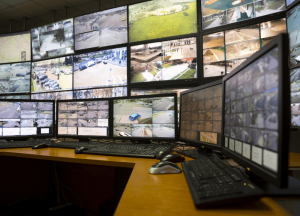
Mirroring one control room's view across a whole transit network
At a glance
- AV-over-IP transports video, audio, and control signals over standard Ethernet networks instead of dedicated coax or fiber matrix wiring.
- Encoders at the source and decoders at each display convert video to network packets and back, so a single feed can be sent to any number of sites without additional cabling.
- Precision Time Protocol (PTP) and matched decoder buffering keep multiple sites displaying the same frame at the same moment, which is what makes shared delay metrics meaningful across locations.
- Because AVoIP rides on standard 1GbE or 10GbE infrastructure, regional dispatch stations can receive the main hub’s feeds over existing wide-area network links rather than new dedicated runs.
- Datapath’s Aligo, Arqa, and ActiveSQX ranges apply AVoIP encoding and decoding to control room and multi-site KVM deployments, with Aetria providing centralized routing and layout management across sites.
What does "AV-over-IP" actually mean for a transit network?
AV-over-IP describes any system that encodes video, audio, and control data into IP packets so it can travel across a standard network switch fabric instead of a purpose-built AV matrix. In a transit command center, this typically means camera feeds, train describer data, SCADA overlays, and PA/PIS status screens are each captured by an encoder, placed on the network, and pulled down by decoders wherever they are needed. That is a structural change from a traditional matrix switcher, which physically routes a fixed number of sources to a fixed number of destinations over dedicated cabling. An IP-based system routes logically instead, which means the same source can be sent to one display or a hundred without running new cable, and a new dispatch site can be added by connecting it to the existing wide-area network (WAN) rather than trenching new signal runs to a control room miles away.
For transit operators specifically, this matters because the video sources that matter, platform cameras, concourse cameras, signal status boards, are rarely located next to the people who need to watch them. AVoIP removes the assumption that a video source and its viewers are in the same building.
Want to see this in action?
See how Aetria coordinates layout and source routing across a live multi-site control room deployment.
How does a main hub mirror its feeds to remote dispatch stations?
The main transit hub’s encoders place each video source on the network as a stream. Regional dispatch stations then subscribe to whichever streams they need through decoders on their own local displays or video walls. Because the routing is handled at the network layer, the same camera feed reaching the main control room’s video wall can reach a regional dispatcher’s monitor at the same time, over the same network path class, without a second physical connection back to the source.
This is different from simply “streaming” video to a remote office. A dispatch station is not just watching a copy of the feed after the fact; it is displaying the same live signal path, decoded locally, so operators at both ends are working from a shared and current picture. Multicast network configurations are commonly used here, letting one encoded stream serve many decoders across sites without the source having to send a separate copy to each destination, which keeps bandwidth demand from scaling linearly with the number of remote stations.
Why routing logic matters more than distance
Once video exists as IP traffic, “how far away is the dispatch station” becomes a network design question rather than a video engineering one. A regional site 40 miles from the main hub is reachable the same way a site three floors down is reachable, provided the WAN link between them has the bandwidth and quality of service (QoS) prioritization the video streams need. This is a meaningful shift for transit authorities that have historically treated remote command centers as separate systems requiring their own local recording and monitoring hardware.
Camera & source encoding
Source-side capture
Decoder placement
Display at every dispatch site
Time synchronization
Frame alignment across sites
Network efficiency
Multicast distribution
Control & permissions
Centralized routing with Aetria
Aetria gives operators a single interface to route sources, manage layouts, and set viewing permissions across every connected site.
Why does latency matter when everyone is looking at the same delay metrics?
Transit command centers frequently display delay metrics, live countdowns, and incident timers alongside video. If the video feed at a regional dispatch station lags behind the main hub by an inconsistent or unknown amount, operators comparing notes over radio or phone are effectively working from two different versions of “now.” Low, consistent latency and reliable frame synchronization mean the delay metric a main hub controller reads matches what the regional dispatcher sees at the same instant, so decisions being made across sites are based on the same information rather than a stale or drifting copy of it.
This is why AVoIP system design for transit applications focuses as much on synchronization as on raw latency. A feed that arrives one second late but is consistent and synchronized across every site is more operationally useful than one that arrives faster but drifts unpredictably relative to other displays on the network.
Talk to a specialist
Discuss latency and synchronization requirements for a multi-site AVoIP deployment.
What does a typical AVoIP transit command center architecture look like?
Source layer
Cameras, SCADA overlays, and status feeds connect to encoders at or near the main hub. Each encoder places its stream on the network under network administrator control, following the same access and security policies as any other network device.
This is why AVoIP system design for transit applications focuses as much on synchronization as on raw latency. A feed that arrives one second late but is consistent and synchronized across every site is more operationally useful than one that arrives faster but drifts unpredictably relative to other displays on the network.
Network layer
Display layer
Frequently asked questions
Is AV-over-IP the same as streaming video over the internet?
How many remote dispatch stations can view the same source?
As many as the network and licensing allow. Because AVoIP sources are placed on the network rather than physically wired to a fixed number of outputs, adding a dispatch station is a routing change, not a cabling change.
What keeps multiple sites synchronized to the same frame?
Does AVoIP require a dedicated network separate from other transit systems?
It does not require a physically separate network, but most transit deployments use VLAN segmentation and QoS prioritization to protect video traffic from congestion caused by unrelated systems sharing the same infrastructure.
Can a regional dispatch station control a source at the main hub?
Yes, when paired with an IP KVM solution such as Datapath Aligo or Datapath Arqa, which extend keyboard, video, and mouse access over the same network used for video distribution.
What happens if the WAN link to a remote site goes down?
The remote site loses its live feed until the link is restored. Transit authorities typically design redundant WAN paths and local failover displays for dispatch stations that cannot tolerate any loss of visibility.
Does AVoIP replace the need for a video wall controller?
No. A video wall controller such as Datapath’s VSN Series still manages scaling, layout, and bezel compensation for the physical display array; AVoIP determines how sources reach the controller and other decoders across the network.
How is source access controlled across multiple dispatch sites?
Centralized management platforms such as Aetria let administrators set viewing and routing permissions per site or per operator, so regional stations only see the sources they are authorized to access.
Planning a multi-site transit command center
Talk to our team about synchronizing video, KVM, and control across every dispatch station on your network.