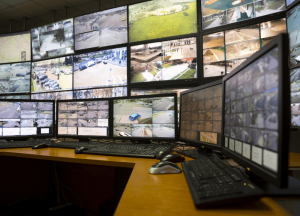
One operator. One mouse. Every network, every source.
In a busy control room, every second of operator attention matters. Yet many facilities still seat their operators in front of a sprawl of keyboards, mice, and monitors one input device for each network or system they manage. A KVM (keyboard, video, and mouse) switching platform combined with unified management software eliminates that physical clutter by allowing a single operator to move fluidly between sources, networks, and applications from one seat, using one mouse. The result is a faster, more reliable operation and a workspace that scales without adding hardware.
At a glance
- A unified control room platform lets a single operator control multiple networks and source systems from one keyboard and mouse.
- IP-based KVM solutions like Datapath Aligo and Arqa allow cross-network switching without physically moving between desks or devices.
- Mouse glide allows the cursor to cross display boundaries continuously, as if all screens share a single desktop.
- Aetria’s operator management layer controls which sources and systems each user can access, with permissions enforced at the software level.
- Hardware-based processing maintains sub-1ms switching latency, keeping control room responsiveness consistent under peak load.
Explore Datapath Aligo
Intelligent 4K IP KVM built for multi-network control room environments.
What is the multi-keyboard problem?
Walk into a traditional control room and you will often find operators surrounded by a ring of peripherals. Each secure network, each source system, and sometimes each video wall zone has its own dedicated workstation. Operators physically swivel between chairs or lean across desks to interact with each one.
The problem compounds as operations grow. Adding a new network segment means adding another computer, another monitor, another keyboard and mouse. Floor space runs out. Cable management becomes its own discipline. And when an incident demands fast action across multiple systems simultaneously, the operator’s body becomes the bottleneck.
How does mouse glide across networks actually work?
Mouse glide, sometimes called pointer roaming or KVM cursor sharing, allows an operator’s cursor to pass from one screen to another without any manual switching action. In an IP KVM environment, this works by transmitting the HID (Human Interface Device) signal, the mouse position and click events over the network to whichever host the cursor currently occupies.
Datapath Aligo (4K, AVoIP) and Arqa (HD, AVoIP) extend this across network boundaries. An operator can position a window from their secured network on the left display, their public monitoring feed in the center, and their communication application on the right. All reachable with one uninterrupted cursor movement. No hotkey sequence, no physical switch, no attention break.
The key constraint in cross-network KVM is security policy, not technology. Aligo and Arqa are designed to operate within strict network segmentation. Aetria’s permission layer ensures that only credentialed operators can roam across specified network boundaries.
Why hardware processing matters for control room switching
Software-only KVM and display management solutions introduce latency at the point of encode and decode. For most office environments that is acceptable. For a control room managing live video feeds, real-time telemetry, or broadcast sources, it is not. A delayed cursor response or a frame drop during a critical switching action degrades operator confidence and slows decision-making.
Datapath’s hardware-based approach offloads video processing from the host CPU. The Datapath VSN Series handles signal routing, scaling, and wall management in dedicated silicon. Aligo encodes and decodes 4K KVM signals in hardware at less than 1ms of latency. The host workstation experiences no processing overhead, and the operator experiences an environment that feels local even when the physical hardware is rack-mounted in a separate plant room.
See how Aetria manages operator access
Centralized permissions, source routing, and layout control across multi-site deployments.
What does unified management software add beyond KVM switching?
KVM switching handles the peripheral layer who controls what with which mouse and keyboard. A platform like Aetria handles the operational layer above that.
Aetria is Datapath’s control room management and operation platform. It gives operators a single interface from which to route video sources, arrange display layouts, launch predefined scenes, and transition between operational modes. Rather than an operator manually reconfiguring a video wall during a shift handover or incident response, Aetria makes those transitions a matter of loading a saved layout or pressing a soft button.
Permissions are role-based. A supervisor can access any source and modify any layout. A junior operator might be locked to a defined set of feeds and a fixed display arrangement. When a critical event requires a specific view, a scene preset can be triggered in a single action not constructed piece by piece under pressure. And because Aetria is centralized, those configurations apply consistently whether the operator is sitting at their primary desk, using a remote workstation, or accessing the system through a mobile interface.
How does this apply to multi-site operations?
The same principles that remove the multi-keyboard problem from a single desk apply across geographies. A control room in London and a backup facility in Birmingham can share source routing permissions, synchronized layout states, and operator credential management through a single Aetria deployment.
Operators at either site can view and interact with the same source pool, subject to their permissions. This matters for organizations that run follow-the-sun monitoring, disaster recovery hot-standby facilities, or distributed editorial teams. The physical infrastructure at each site may be local with the VSN Series controllers, Aligo transmitters and receivers, but the operational layer is unified.
Input Management
Cross-network source routing
Aetria aggregates sources from multiple network segments into a single routing layer. Operators select and place sources without needing to know which physical device or network they originate from.
Peripheral Control
Hardware IP KVM with mouse glide
Datapath Aligo and Arqa transmit HID signals at hardware speed over IP, allowing uninterrupted cursor movement across authorized network boundaries with sub-1ms response.
Display Management
Video wall layout and scene control
The Datapath VSN Series processes up to 32 display outputs at up to 4K per output. Aetria’s scene management allows operators to switch full wall configurations in a single action.
Operator Permissions
Role-based access and credentialing
Aetria assigns source access and layout permissions at the user level. Operators can only interact with the systems and views their role authorizes, enforced in software.
Signal Processing
Hardware-based encode and decode
Dedicated processing silicon in Aligo and the VSN Series removes encode/decode overhead from host workstations, keeping system performance consistent under peak operational load.
Multi-site Operations
Centralized management across locations
A single Aetria instance can govern source routing, layout states, and operator permissions across geographically distributed facilities, with consistent policy at every site.
Frequently asked questions
What is the multi-keyboard problem in a control room?
How does IP KVM allow an operator to use one mouse across multiple networks?
IP KVM solutions like Datapath Aligo encode keyboard and mouse signals and transmit them over a standard IP network to the host they are assigned to. Mouse glide technology tracks the cursor position across screens and automatically redirects the HID signal to the appropriate host as the cursor crosses the display boundary. This makes cross-network switching invisible to the operator.
What is the difference between Aligo and Arqa?
Aligo is Datapath’s intelligent 4K AVoIP KVM solution, designed for high-resolution environments where 4K per source is required. Arqa is the HD AVoIP KVM solution, suited to environments where 1080p resolution is sufficient and cost efficiency is the priority. Both support IP-based transmission, mouse glide, and integration with Aetria.
Is cross-network KVM secure?
Yes, when implemented correctly. Datapath Aligo and Arqa operate within defined network segmentation boundaries using KVM signals traversing only authorized paths. Aetria adds a permission layer that restricts which operators can roam across which network boundaries. Physical network isolation is maintained; the KVM platform does not create a bridge between classified and unclassified networks.
What is Aetria and how does it relate to KVM switching?
Aetria is Datapath’s control room management and operation platform. Where KVM switching manages the physical peripheral layer (who controls what), Aetria manages the operational layer source routing, display layout, scene presets, and operator permissions. Together they give an operator a unified interface that covers both input control and display management.
How many display outputs can the VSN Series support?
The Datapath VSN Series is a configurable video wall controller that supports up to 32 display outputs at up to 4K resolution per output. It is designed for large-format control room video walls and scales from small deployments to enterprise-scale installations.
Can Aetria manage operators across multiple physical sites?
Yes. A single Aetria deployment can govern source routing, layout states, and operator permissions across geographically distributed facilities. This supports use cases including disaster recovery hot-standby operations, follow-the-sun monitoring, and distributed editorial or broadcast control environments.
Does hardware-based KVM processing affect host computer performance?
No. Datapath’s hardware-based approach offloads video encoding and decoding in Aligo for KVM, and in the VSN Series for video wall processing. The host workstation handles no additional processing overhead, which is particularly important in control rooms where host machines are running resource intensive applications concurrently.
Ready to simplify your control room operation?
Talk to our team about IP KVM, video wall control, and the Aetria platform for your environment.