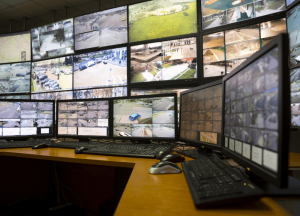
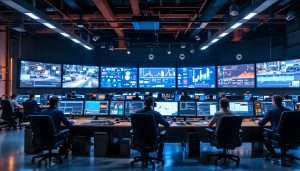
A security control room is the operational nerve center of any large-scale safety or security operation and the display technology at its core determines how fast operators can detect threats, communicate, and respond. If your organization is designing or upgrading a security control room, understanding what it needs to do and what hardware must support it is the essential starting point.
What is a security control room?
A security control room is a dedicated facility that serves as the central hub for monitoring, coordinating, and managing security systems across one or more sites. It integrates feeds from surveillance cameras, access control systems, alarm systems, fire detection, and other real-time data sources into a single, unified operational environment.
Security control rooms operate continuously typically 24 hours a day, 365 days a year staffed by trained operators whose role is to detect incidents early and coordinate an appropriate response. These environments range from small on-site security suites at corporate campuses or sports venues to large-scale national infrastructure control centers managing hundreds or thousands of simultaneous input sources.
Free whitepaper: Key considerations for control room setup
Download our guide covering display architecture, operator workflow, and system scalability.
What is a security control room?
Security control rooms perform five core operational functions. Each one depends on operators having fast, clear, and unambiguous access to the right information at the right time, which is fundamentally a display and processing challenge.
Function 01
Monitoring and surveillance
Function 02
Incident response
Function 03
Communications
Function 04
Access control management
Function 05
Record keeping
Logging all incidents, system alerts, and operator actions for audit trails, compliance, and post-incident review.
All Functions
Require real-time display clarity
What does a security control room operator do?
A security control room operator is responsible for active monitoring and real-time decision-making across multiple security systems simultaneously. Operators are typically assigned to a defined area of responsibility. For example, monitoring perimeter cameras at a stadium or managing access points across a hospital campus.
But they also need visibility of the broader operational picture, which is why shared video walls are a standard feature in well-designed security control rooms.
Key operator tasks include:
- Watching surveillance feeds and flagging abnormal activity
- Responding to triggered alarms and assessing escalation requirements
- Managing access control systems to authorize or deny entry
- Coordinating with on-site personnel and external services during active incidents
- Documenting events with accurate timestamps, locations, and descriptions
How many sources does a security control room handle?
In modern security operations, the number of sources requiring simultaneous monitoring has grown significantly. It is not uncommon for a security control room to manage hundreds of inputs, including CCTV cameras, live satellite feeds, building management system dashboards, web-based monitoring portals, and custom security software interfaces all requiring real-time display and control.
This scale creates a direct requirement for video wall controllers and display management software that can handle high source counts without compromising image quality, introducing latency, or limiting operator flexibility in how content is arranged on screen.
Aetria: centralized control room management
One platform to manage video walls, workstations, and displays designed to scale as your operation grows.
What technology does a security control room require?
Video wall processors
A video wall processor is the hardware at the heart of any serious security control room display setup. It takes multiple signal inputs including HDMI, DisplayPort, SDI, IP streams and distributes them across a multi-display array with precise pixel mapping and bezel compensation. The processor determines how many sources can be displayed simultaneously, at what resolution, and with what degree of flexibility for operators to rearrange content on the fly.
For mission-critical environments, video wall controllers must support redundancy, low-latency signal handling, and the ability to scale output across large display arrays without degradation.
Display management software
AV over IP (AVoIP) and KVM
Frequently asked questions
What is the difference between a security control room and a NOC?
A security control room focuses on physical security monitoring, CCTV, access control, alarms, and incident response. A Network Operations Center (NOC) monitors IT infrastructure: servers, networks, and connectivity. In some organizations these environments converge into a unified operations center, but they have distinct operational responsibilities and often different display and software requirements.
How many operators does a security control room need?
Staffing levels depend on the number of sources being monitored, the complexity of the operation, and shift patterns. A small facility may operate with a single operator per shift, a large national infrastructure site may require dozens of operators with defined areas of responsibility. Display systems should be designed so individual operator workstations can pull any source to their screen, and the shared video wall can be updated without interrupting other operators.
What video wall technology is best suited for security control rooms?
Security control rooms require video wall controllers with high source counts, low-latency processing, and flexible display management software. LED video walls or high-brightness LCD panels are common display choices. Datapath’s VSN Series must support bezel compensation, pixel-accurate mapping across displays, and the ability to save and recall operator defined layouts instantly. Redundancy and continuous operation reliability are non-negotiable requirements.
Can a security control room be managed remotely?
Yes. AVoIP and KVM extension technologies allow operators to monitor and control remote systems without being physically co-located with source hardware. Centralized management platforms like Aetria can also be administered remotely by system managers, allowing display layouts and source assignments to be updated without operator interruption. This is increasingly important in multi-site security operations.
How do you design a security control room from scratch?
Designing a security control room?
Talk to Datapath's team about display processing, video wall controllers, and scalable control room architecture or download our technical whitepaper to start your planning.