One shared view of the road network, from sensor to screen
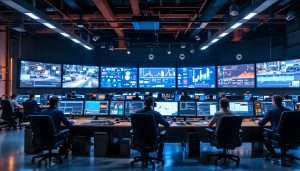
A traffic management control room is the operational hub where teams monitor road networks, detect congestion, and coordinate incident response using live data and video. The future of traffic management control rooms rests on three shifts. Connected infrastructure feeds more real-time data. Congestion monitoring surfaces problems earlier. CCTV (closed-circuit television) puts visual context in front of the right operator at the right moment. Video wall processing brings these inputs together so the whole team works from one picture.
At a glance
- A modern traffic management control room combines sensor data, CCTV, and incident systems on one shared video wall.
- Connected infrastructure includes roadside sensors, signal controllers, and variable message signs that report status over IP networks.
- Congestion monitoring works best when data dashboards and camera feeds appear side by side on the same display surface.
- AVoIP (audio video over IP) lets operators route any camera to any display without dedicated cabling for each source.
- Datapath Aetria provides centralized layout management, source routing, and operator permissions for control room operations.
Want to see this in action?
Talk to our specialists about control room design for transport networks.
What is a modern traffic management control room?
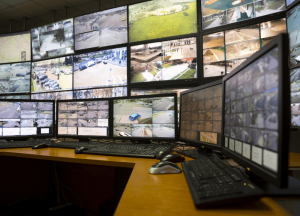
Operators watch a road network through many sources at once. These include CCTV cameras, traffic signal status, variable message sign controls, journey time data, and emergency service feeds. A modern room brings these into one shared environment.
Instead of each system owning its own monitors, a video wall controller places any source on any part of the wall. Layouts then change as conditions change.
How does connected infrastructure change traffic control rooms?
Connected infrastructure turns roadside equipment into live data sources. Sensors, cameras, signals, and message signs report to central systems over IP networks, which multiplies the number of sources an operator can reach. The control room’s job shifts from watching fixed feeds to selecting the right feed at the right moment.
This puts pressure on signal distribution. Sources arrive as IP streams, HDMI, or DisplayPort from operator workstations, so the display system must accept mixed formats and scale them cleanly. Datapath’s ActiveSQX range provides scalable IP encode and decode for mixed environments like this.
How do operators monitor congestion across a whole network?
Effective congestion monitoring pairs data with visuals. A speed map or journey time dashboard shows where flow drops, and the nearest camera shows why. With both side by side on the wall, an operator confirms a slowdown in seconds instead of switching between applications.
Layouts that follow the event
Preset layouts let operators recall a corridor view, a junction view, or a full incident view with one action. Pixel mapping and bezel compensation keep imagery accurate across display edges, so road markings and on-screen text stay readable on large walls.
Why does CCTV wall design matter for incident response?
In an incident, operators need context first: what happened, where, and who is affected. CCTV over IP lets any camera reach any display or operator workstation without dedicated cabling for each source.
Aligo, an intelligent 4K IP KVM (keyboard, video, mouse) system, gives operators remote access to source computers from their desks. Arqa covers HD IP KVM requirements for other positions.
Free guide: key considerations for control room video walls
Plan display layout, source routing, and resilience before you build.
How should incident response work on the video wall?
Good incident response follows a repeatable sequence:
- Detection triggers an alert from a sensor, camera analytics, or a caller.
- The operator pulls up the relevant cameras and data sources.
- The wall shifts to an incident layout the wider team can see.
- The wall returns to the standard view once the incident closes.
Centralized management keeps this sequence consistent between shifts and between sites. Aetria handles layout control, source routing, and permissions, so each operator sees and controls what their role requires.
Frequently asked questions
What is a traffic management control room?
A traffic management control room is a central facility where operators monitor road networks, manage congestion, and coordinate incident response. It combines live data, CCTV, and communication systems on shared displays. Operators use it to keep traffic moving and to direct emergency response.
How do control rooms monitor traffic congestion?
Control rooms combine data sources, such as journey time and speed dashboards, with CCTV feeds. Operators view both together on a video wall to confirm where congestion starts and why. Preset layouts speed up the switch between network, corridor, and junction views.
What role does CCTV play in traffic incident response?
CCTV gives operators visual confirmation of an incident’s location and severity. This informs decisions on message signs, lane control, and emergency dispatch. IP-based distribution lets operators send any camera to any display quickly.
What is a video wall controller and why do traffic control rooms use one?
A video wall controller distributes and scales video signals across multiple display outputs from a single management interface. Traffic control rooms use one to place any source in any window and change layouts as conditions change. Datapath’s VSN Series offers configurable video wall controllers for this purpose.
What is AVoIP and how does it apply to traffic management?
AVoIP (audio video over IP) sends video and audio across standard network infrastructure instead of dedicated point-to-point cabling. In a control room, it lets any source reach any display or workstation through the network. This simplifies expansion as new cameras and systems join.
How does connected infrastructure affect control room design?
Connected infrastructure increases the number and variety of sources feeding the room. Designers need flexible input handling, scalable IP encode and decode, and centralized layout management. Planning for growth in sources matters as much as planning for today’s display count.
Plan the future of your traffic management control room
Talk with Datapath about video wall processing, IP KVM, and control room management for your network.