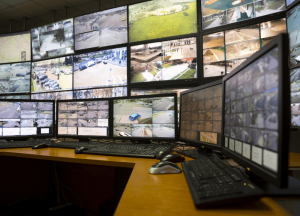
AV-over-IP (Audio-Visual over Internet Protocol) is a distribution architecture that transmits video, audio, and control signals across standard network switches rather than dedicated point-to-point video cabling. Sources and displays connect to the network as individual nodes, and the management software routes content between them as required. Standards such as NDI, SDVoE, and SMPTE ST 2110 define how that signal is encoded, packetized, and decoded across the network.
For control rooms and large-scale AV deployments, IP distribution reduces the need for long dedicated cable runs, simplifies adds and changes, and enables content sharing between rooms, buildings, or sites. The Datapath Aligo and Arqa KVM products extend this further by transmitting keyboard, video, and mouse (KVM) control over IP, allowing operators to access remote workstations from a central desk as if the equipment were local.
What are the trade-offs of AV-over-IP compared to traditional video distribution?
The primary trade-off is network dependency. An IP distribution system requires a correctly configured, low-latency network infrastructure to perform reliably at scale. Bandwidth, multicast routing, Quality of Service (QoS) configuration, and network resilience all need to be assessed during the design phase. Properly specified, an IP-based system outperforms traditional matrix-switched architectures for scalability and flexibility. In mission-critical environments, network redundancy should be factored into the design from the outset.
Free guide: key considerations for control room video wall deployments
Everything AV designers and system integrators need to evaluate before specifying a control room video wall platform.
Frequently asked questions
What is AV-over-IP video distribution?
AV-over-IP technology allows video, audio, and control signals to be transmitted across standard network infrastructure rather than dedicated video cabling. This provides greater flexibility, scalability, and easier deployment for modern control rooms.
What are the advantages of IP-based video distribution?
IP-based video distribution enables organizations to:
- Share content between locations
- Scale systems more easily
- Reduce infrastructure complexity
- Simplify system expansion
- Improve flexibility for future upgrades
Can video wall content be shared with other control rooms or locations?
Yes. Modern video distribution technologies allow content to be shared between control rooms, remote operation centres, and other facilities, helping organizations maintain situational awareness across multiple sites.
How are video sources managed in a control room environment?
Video sources are typically managed through a centralized platform that allows operators to discover, organize, assign, and display content wherever it is needed throughout the control room ecosystem.
Does video wall technology support high-resolution content?
Modern video wall solutions support high-resolution content, including Full HD and 4K sources, ensuring operators can view critical information with clarity and detail.
Can users control video walls without specialist training?
Modern control room solutions are designed to simplify operation through intuitive user interfaces, touchscreen controls, drag-and-drop workflows, and predefined layouts that allow users to manage content without requiring extensive technical knowledge.
How does video wall technology improve situational awareness?
By bringing together information from multiple systems into a single visual environment, video walls enable teams to identify issues more quickly, monitor ongoing events, and make informed decisions based on a complete operational picture.
What should organizations look for in a video wall management solution?
Key considerations include scalability, ease of use, integration capabilities, reliability, centralized management, workflow automation, security, multi-site support, and compatibility with existing control room technologies.’
Ready to design your next control room video wall?
Talk to our specialists about VSN Series controllers, Aetria management software, and IP distribution for your project.