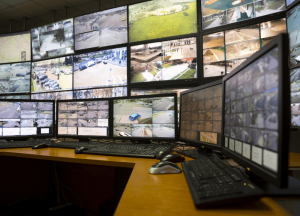
Where production data, safety systems, and incident response come together on one screen.
An effective oil and gas control room gives operators a single, real-time view of production data, safety systems, and environmental monitoring, so incidents can be identified and acted on before they escalate. That means unifying SCADA (supervisory control and data acquisition) feeds, emergency shutdown status, CCTV, weather and emissions data, and communications tools onto shared displays that every operator, engineer, and site manager can read at a glance. The physical and technical design of the room, not just the software running inside it, determines how quickly a team can move from detection to decision during a live event. Get the display architecture wrong, and even well-trained operators lose critical seconds hunting between screens. Get it right, and the control room becomes the single source of truth for the entire site.
At a glance
- An effective oil and gas control room brings production monitoring, safety systems, and environmental data onto one shared visual display rather than isolated workstation screens.
- A video wall controller lets operators route, scale, and layer multiple data sources onto a single large-format display without manually switching between individual monitors.
- Redundant hardware and automatic failover are essential in continuously staffed control rooms, where an unplanned display outage can delay incident response.
- Centralized control room management software allows operators to save and instantly recall pre-configured layouts for specific incident types, such as a gas release or process upset.
- Bezel compensation keeps data, maps, and camera feeds aligned correctly across multi-screen video walls, avoiding visual distortion at panel seams.
Continuous monitoring with zero tolerance for downtims
What does an oil and gas control room actually need to monitor?
A production-focused control room typically tracks three parallel data streams at once. Production monitoring covers flow rates, pressure, temperature, and equipment status across wellheads, pipelines, and processing units, usually delivered through a SCADA or DCS (distributed control system) interface. Safety systems cover emergency shutdown (ESD) status, fire and gas detection, alarm management, and access control. Environmental monitoring covers emissions, flaring, spill detection, and weather conditions that affect both operations and evacuation planning.
Each of these streams typically originates from a different system, often from a different vendor, and historically each has lived on its own dedicated monitor. That approach works when everything is running normally. It breaks down the moment an operator needs to correlate a pressure spike on the production side with an alarm on the safety side and a weather warning on the environmental side, all within seconds.
Want to see this in action?
See how a single video wall controller consolidates SCADA, CCTV, and environmental feeds for control room operators.
How do safety systems fit into the video wall environment?
Safety systems carry the highest operational weight in any oil and gas facility, and the display architecture has to reflect that. Emergency shutdown status, fire and gas panel data, and critical alarms need guaranteed visibility, which means they should never be at risk of being buried behind another window or lost if a single source fails.
Prioritized layout, not just more screens
Redundancy is a safety requirement, not a nice-to-have
Why does environmental monitoring belong on the same wall as production data?
Environmental conditions directly affect operational decisions, which is why separating them from production and safety data creates blind spots rather than clarity. Wind direction and speed affect gas dispersion modeling during a release. Weather radar affects whether a helicopter evacuation is viable. Emissions and flare monitoring data can indicate an upstream process problem before it shows up on a production dashboard.
Bringing environmental feeds onto the same video wall as production and safety systems means operators are working from one consistent picture of site conditions, rather than reconciling data across separate screens or separate rooms. In an incident, that consistency removes a step between observing a condition and acting on it.
How do teams collaborate during an operational incident?
Operational incidents rarely stay contained to a single room. A control room operator, a site safety officer, an engineer working remotely, and a regional operations center may all need visibility into the same event at the same time, often across multiple physical locations.
Centralized control room management software, such as Datapath’s Aetria platform, addresses this by letting authorized users route sources, recall layouts, and view the same wall content from multiple sites, with permission levels that control who can view versus who can actively manage the display. During an incident, a predefined “incident response” layout can be recalled instantly, bringing the relevant camera feeds, SCADA screens, and communication tools to the front for every connected location, rather than requiring each site to manually rebuild its own view under pressure.
Managing displays across multiple sites?
Aetria centralizes layout control, source routing, and operator permissions across every connected control room.
What role does a video wall controller play in oil and gas control room design?
The video wall controller is the piece of hardware that makes all of the above possible. It takes in multiple video and data sources, whether from SCADA workstations, IP cameras, NDI (Network Device Interface) streams, or standard HDMI and DisplayPort inputs, and scales and positions them across a multi-panel display through multi-head display outputs.
In a well-specified oil and gas control room, the controller also handles EDID (Extended Display Identification Data) management so displays are recognized correctly at startup, and bezel compensation so that content spanning multiple panels lines up visually without gaps or misalignment at the seams. Hardware-based processing, rather than a software-only approach running on a general-purpose PC, reduces the risk of the video wall going down alongside the rest of the control room network during an IT incident.
Frequently asked questions
What is the difference between a control room video wall and a standard multi-monitor setup?
A video wall uses a dedicated controller to treat multiple screens as one continuous canvas, with sources scaled and positioned across panels. A standard multi-monitor setup simply extends a desktop across separate screens, without centralized layout control or bezel compensation.
Why do oil and gas facilities need bezel compensation?
Can a control room video wall display SCADA and CCTV feeds at the same time?
Yes. A video wall controller with multiple input types can display SCADA workstation output, IP camera feeds, and other sources simultaneously on the same wall, resized and positioned according to a saved layout.
What is EDID management and why does it matter in a control room?
How does a control room maintain uptime if hardware fails?
Redundant video wall controllers and failover switching allow a secondary hardware path to take over automatically if a primary component fails, keeping safety and production data visible without manual intervention.
Can multiple sites view the same control room display remotely?
With centralized control room management software, authorized users at other locations can view the same live wall content and, depending on permission level, recall layouts or route sources without needing to be physically present in the room.
What data sources typically feed into an oil and gas control room video wall?
Is a hardware-based video wall controller better than a software-only solution for critical infrastructure?
Ready to design a control room built for critical operations?
Talk to our team about video wall controllers and collaboration tools built for continuous, safety-critical environments.