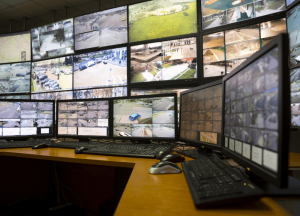
Fusing SCADA, CCTV, GIS, weather and outage data into a single operational view
SCADA (Supervisory Control and Data Acquisition) tells a utility control room what the grid is doing, but not why. Modern control rooms combine SCADA with CCTV, GIS (Geographic Information System) mapping, live weather data, and outage management systems on a shared video wall so operators can see the full picture during a fault, not just the alarm. This combination shortens the time between an alarm firing and a crew being dispatched to the right location with the right context. The result is faster restoration and fewer misdirected truck rolls.
At a glance
- A utility control room combines SCADA, CCTV, GIS, weather data, and outage management systems on a single visual display to give operators full situational awareness during faults.
- SCADA reports the electrical state of the grid, but it does not show weather conditions, field crew positions, or the volume of customer outage calls that explain why a fault occurred.
- A video wall controller lets operators route and resize any of these sources on one wall without switching between separate monitors or workstations.
- The Datapath VSN Series supports up to 32 display outputs at up to 4K resolution per output, with hardware-based processing adding less than 1ms of latency.
- Aetria provides centralized layout management, source routing, and operator permissions across multi-site control room deployments.
What is SCADA and why isn't it enough on its own?
SCADA is the system utilities rely on to monitor and control field assets remotely, substations, feeders, breakers, and transformers, reporting their status back to the control room in real time. It is the backbone of grid operations and the first place an operator sees an alarm.
SCADA’s limitation is that it only reports what its sensors are wired to measure. It cannot show an operator what a downed line looks like, whether a storm front is approaching a substation, or how many customer calls are coming in from a specific neighborhood. Those data points live in separate systems, and during a fast-moving fault, switching between them costs time operators do not have.
What other data sources do utility control rooms need?
Four systems consistently sit alongside SCADA in a well-equipped control room:
CCTV (closed-circuit television)
- Fixed and pan-tilt-zoom cameras at substations and along critical corridors, giving operators a direct visual check on physical conditions
GIS mapping
- A geographic view of the network showing exactly which feeders, transformers, and customers are affected by a given fault
Weather data
- Live radar, lightning tracking, and wind speed feeds that explain environmental causes and help predict where the next fault is likely
Outage management systems (OMS)
- Aggregated customer call and smart meter "last gasp" data that confirms the scope of an outage independently of SCADA telemetry
Want to see multi-source fusion in action?
See how Aetria brings SCADA, CCTV, GIS, and weather feeds into one operator view.
How does combining these sources improve fault response times?
Consider a downed line during a storm. SCADA flags the feeder as de-energized within seconds. On its own, that alarm tells an operator a fault exists, but not its cause, severity, or exact location relative to crews and customers.
With systems fused on one wall, the same event plays out differently. GIS highlights the exact feeder segment and the number of customers affected. CCTV, if a camera is nearby, confirms whether the cause is weather, vegetation, or a vehicle strike. The weather overlay shows whether high winds or lightning are still active in the area, which affects crew safety and dispatch timing. The OMS confirms customer call volume matches the SCADA alarm, ruling out a false trip.
Instead of an operator toggling between four separate applications to build this picture, it is already assembled. That difference, measured across an entire storm event, is what separates a control room that reacts to alarms from one that manages outcomes.
How does a video wall controller unify SCADA, CCTV, GIS, and weather feeds?
A video wall controller is the hardware and software layer that takes multiple independent video sources, SCADA HMI (human-machine interface) screens, IP camera streams, GIS software, and weather feeds, and displays them as flexible, resizable windows across one physical wall of displays.
Multi-head display outputs and pixel mapping
EDID management
Ready to spec a video wall controller?
The Datapath VSN Series supports up to 32 outputs at up to 4K resolution with sub-millisecond processing latency.
What role does Aetria play in multi-site utility operations?
Aetria is Datapath’s centralized control room management platform. Where a video wall controller handles the physical display of sources, Aetria manages how those sources are organized, who can control them, and how quickly an operator can switch between operational states.
For utilities running multiple control centers, this matters in two specific ways. First, layout presets let an operator switch instantly from a standard monitoring layout to a storm response layout, where GIS, weather, and outage data are prioritized over routine SCADA screens. Second, operator permissions ensure that source routing changes made by one operator, at one site, follow the same governance rules across every site in the network.
Frequently asked questions
What does SCADA stand for and what does it do in a utility control room?
Why do utility control rooms need more than SCADA?
What is a video wall controller and how does it help fault response?
A video wall controller is hardware and software that combines multiple independent video sources into one flexible display across a wall of screens. It lets operators see SCADA, CCTV, GIS, and weather data together instead of switching between separate workstations.
Can GIS mapping and CCTV feeds be displayed alongside SCADA on the same wall?
Yes. A video wall controller treats each source, including GIS software, CCTV streams, and SCADA HMI screens, as an independent window that can be resized, moved, or layered on the same canvas.
How does combining weather data with SCADA alarms improve outage response?
What is Aetria and how does it support multi-site control rooms?
Aetria is Datapath’s centralized control room management platform. It manages layout presets, source routing, and operator permissions consistently across multiple control center sites.
Does adding a video wall controller slow down SCADA response times?
No. Hardware-based video wall processing, such as the Datapath VSN Series, adds less than 1ms of latency, so SCADA alarms and live feeds remain effectively real time.
What display outputs does the VSN Series support?
The VSN Series supports up to 32 display outputs at up to 4K resolution per output, making it suitable for large multi-source control room video walls.
Bring every data source into one view
See how a video wall controller and Aetria can unify SCADA, CCTV, GIS, and weather data in your control room.